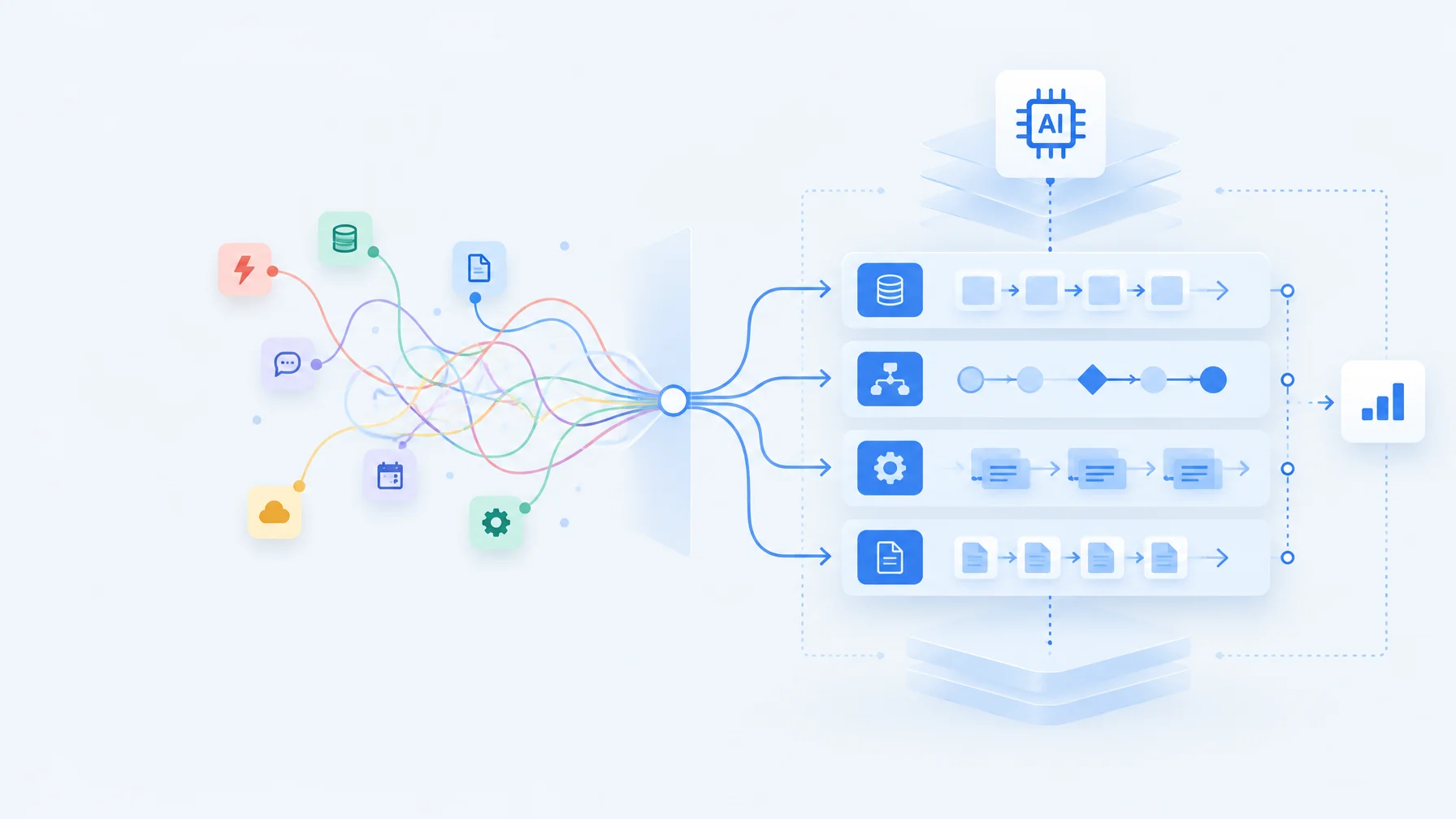
AI workflow automation scales when teams move past no-code task chains into custom production infrastructure: event queues, durable state machines, worker pools, and tenant-safe audit logs. A practical CTO guide for B2B platforms outgrowing Zapier-style automation.
TLDR
- AI workflow automation uses models and rules inside structured process sequences, not one-off chat prompts. IBM frames it as AI systems that perform, coordinate, or enhance work alone or with people.
- No-code connectors win early velocity. They stall when task pricing, rate limits, multi-tenant isolation, exception routing, and audit depth become product requirements.
- Production systems replace brittle point-to-point zaps with event-driven architecture: queues, durable state machines, worker pools, schema gates, and replayable logs. AWS describes EDA as small, decoupled services that publish, consume, or route events.
- McKinsey finds almost all companies invest in AI, yet only 1% of leaders call their deployment mature, with AI fully inside workflows and driving outcomes. Scaling is a leadership and architecture problem. (McKinsey)
- Gartner predicts over 40% of agentic AI projects will be canceled by end of 2027 due to cost, unclear value, or weak risk controls, and still forecasts agentic decisions rising to 15% of day-to-day work decisions by 2028. Build durable process infrastructure first. (Gartner)
- The Blue Box designs automation-first platforms for HealthTech, FinTech, and LegalTech when the product outgrows visual glue.
Table of contents
- What AI workflow automation is
- Where no-code automation wins
- Why no-code hits a production wall
- The custom production stack
- Signals it is time to rebuild
- Migration path without freezing the business
- Vertical patterns: HealthTech, FinTech, LegalTech
- How The Blue Box builds this
What AI workflow automation is
Atlassian defines AI workflow automation as AI that manages complex, dynamic processes beyond rigid if-then rules: models analyze data, recognize patterns, and support decisions across multi-step work. IBM adds that the spectrum runs from a single model classifying a support ticket to multi-agent sequences that research, draft, and review content end to end.
Three layers sit inside a serious definition:
- Trigger and context. An event arrives: form submit, webhook, file upload, EHR order, payment message, contract upload.
- Decision and enrichment. Rules, retrieval, and models classify, extract, score, or propose structured actions.
- Execution and record. Adapters write to systems of record, humans approve when risk thresholds trip, and every step leaves a durable trail.
This is different from "ask ChatGPT for every task." Prompt-by-prompt work is faster manual labor. Automation encodes the process so the same path runs with retries, ownership, and measurable SLAs.
IBM Institute for Business Value research cited by IBM reports that 82% of cross-industry operations executives expect process automation and workflow reinvention to be more effective because of AI agents by 2027. (IBM) That upside only materializes when agents and models sit inside controlled workflows, not free-roaming loops. For the control-plane design of supervised agents, see our guide on AI agents for business with deterministic workflows.
Where no-code automation wins
Visual tools such as Zapier, Make, n8n, and Power Automate earn their place. They connect SaaS apps quickly, let non-engineers ship integrations, and prove ROI on low-risk paths: lead routing, notification chains, simple CRM sync, and internal status updates.
Zapier's public pricing shows the model clearly: plans sell task volume, multi-step zaps, and enterprise controls such as SSO, audit logs, and annual task limits. (Zapier pricing) That is a strong fit when:
- Volume stays inside plan ceilings.
- Failure modes are reversible (resend an email, re-sync a row).
- Data sensitivity stays outside strict multi-tenant product boundaries.
- One or two owners can still explain every live automation.
Early product teams should use no-code to discover which workflows matter. Treat those zaps as a requirements document written in production, not as the final architecture for a platform that sells automation as a product feature.
Why no-code hits a production wall
Intellistack describes the pattern well: the pilot almost never fails; the portfolio does. Build velocity outruns control maturity. Five failure modes show up again and again:
Workflow sprawl. Teams rebuild near-identical logic because nobody can inventory what already runs.
Unknown ownership. The builder leaves. The zap keeps running. Nobody can safely change or retire it.
Permission drift. Automations inherit a builder's broad credentials instead of least-privilege service identities.
Silent failure. A step stops with no alert. The gap surfaces in a customer complaint or audit.
Data duplication. Each connector exports its own copy. Authoritative records fragment.
Add product-grade constraints and the wall gets higher:
- Task economics. High-frequency events (wearable pings, payment webhooks, document pages) multiply tasks. Cost and latency become product P&L, not IT tooling.
- Concurrency and backpressure. Burst traffic needs queues, worker autoscaling, and dead-letter handling, not serial multi-step zaps.
- Tenant isolation. B2B SaaS cannot share connection pools or prompt context across customers.
- Exception depth. Real ops need branching by policy, partial completion, compensation transactions, and human queues with SLAs.
- Audit and replay. Regulators and enterprise buyers ask which model version, which inputs, which policy, and which person approved a write.
Gartner's agentic AI warning maps directly here: projects die on escalating costs, unclear business value, or inadequate risk controls, and many "agent" pitches are rebranded assistants or RPA. (Gartner) If your AI workflow automation plan is a pile of visual chains plus unbounded agent loops, expect the same failure modes.
McKinsey's workplace research makes the leadership point explicit: nearly all companies invest in AI, over 90% plan to increase spend, and only 1% of leaders rate maturity as full workflow integration with substantial outcomes. (McKinsey) The gap is not another connector. It is production infrastructure and operating discipline.
The custom production stack
When AI workflow automation becomes core product behavior, design it like any other mission-critical system. The target shape is event-driven and durable.
1. Event ingress
Normalize every trigger into typed events: source system, tenant id, correlation id, payload schema version, and auth context. Prefer webhooks and change data capture over polling when volume rises.
2. Message queues and backpressure
Publish events to a queue or stream so producers stay decoupled from consumers. AWS stresses loose coupling: small services publish, consume, or route events so you scale, update, and deploy components independently. Queues absorb spikes, enable retries, and feed dead-letter queues for poison messages.
3. Durable workflow / state machine
Long-running work needs explicit states: received, enriching, awaiting_human, executing, compensated, complete, failed. Engines in the Temporal class, Step Functions-style graphs, or custom state stores keep history across crashes and deploys. Stateless request handlers cannot pause a prior-auth packet for two days and resume cleanly.
4. Worker pool and tool adapters
Workers pull jobs, call internal APIs, and invoke models behind typed tool contracts. Each write adapter enforces tenant scope, idempotency keys, and rate limits toward downstream systems. Model calls return structured JSON validated against schemas before anything hits a system of record.
5. Policy, schema, and human gates
Encode decision boundaries in code and config: confidence thresholds, dollar limits, PHI/PCI classes, jurisdiction rules. Low-risk paths auto-complete. High-risk paths open a review queue with a full packet and a hard timeout.
6. Observability and audit ledger
Emit metrics (lag, success rate, cost per run, human override rate) and an immutable execution log: inputs hashed or retained per policy, model/version, policy version, actor, and outputs. Replay a failed run in staging from the same event record.
7. Data plane without silent copies
Prefer live read/write against systems of record with least privilege. When you must materialize data, define ownership, retention, and encryption as first-class design, not connector defaults.
This stack still uses AI. Models classify documents, extract fields, score risk, and draft actions. The difference is that AI steps are activities inside a durable process, not the process itself.
Signals it is time to rebuild
Move a workflow off no-code when two or more of these are true:
- Monthly task spend or latency already affects pricing or SLAs.
- The same automation touches multiple tenants or regulated data classes.
- You need partial failure, compensation, or multi-day human pauses.
- Engineering spends more time babysitting zaps than shipping product.
- Buyers ask for SSO-scoped service accounts, VPC options, or exportable audit trails the visual tool cannot provide.
- You plan agentic steps that write money, care, or legal outcomes.
Keep no-code for peripheral glue: marketing notifications, internal ops alerts, one-off admin tools. Core revenue and compliance paths deserve first-class services.
Migration path without freezing the business
Do not rewrite every zap in one quarter. Strangle the portfolio:
- Inventory. List live automations, owners, systems touched, data classes, and monthly volume.
- Rank. Score by business impact × risk × volume. Migrate the top slice first.
- Shadow. Run custom workers in parallel. Compare outputs without cutting over writes.
- Cut over by event type. Route one event class through the new stack with feature flags.
- Retire. Disable the old zap only after error budgets and audit checks pass.
- Govern. Central connection catalog, naming standards, ownership tags, and quarterly recertification so sprawl does not return inside your own code.
This is the same incremental discipline used in legacy software modernization: keep production online while architecture improves.
Vertical patterns: HealthTech, FinTech, LegalTech
HealthTech and wearable ops
High-frequency device signals and check-ins break task-priced chains. A production path normalizes device payloads, computes sleep and resilience scores, and surfaces coach actions through a controlled dashboard. See Recovery at ENARD / EquipoArg and the product architecture on Recovery. HIPAA-grade RPM designs need continuous telemetry pipelines and strict data boundaries, covered in our HIPAA-compliant healthcare AI and RPM platforms guide.
FinTech operations
Payment, KYC, and risk paths need idempotent writes, dual-control approvals, and examiner-ready lineage. Models can score or extract; state machines own sequencing and kill switches. Unbounded agent loops on ledger writes are a compliance incident waiting to happen.
LegalTech document flows
Clause review and document assembly mix unstructured extraction with binding citation rules. Automation should validate structured outputs, bind sources, and park ambiguous clauses for counsel. Visual multi-app chains rarely preserve the evidence packet an audit needs.
Across all three, AI workflow automation is a product surface: reliability, cost control, and trust are features customers buy.
How The Blue Box builds this
The Blue Box is an automation-first software studio. We design and ship internal platforms, AI-powered products, and mobile/web systems for startups and growing companies across the US and LATAM, with deep work in HealthTech, FinTech, and LegalTech.
Typical engagement shape for teams leaving no-code:
- Map critical workflows and failure modes with your ops and engineering leads.
- Stand up event ingress, queues, and a durable workflow core in your cloud.
- Wrap models behind schema validation, tenant isolation, and human gates.
- Connect systems of record with idempotent adapters and full execution logs.
- Migrate high-value paths first, keep peripheral zaps where they still fit.
Related reading on the blog: Enterprise AI platform build vs buy, AI integration services, and workflow automation for athlete recovery.
If your platform already sells automation to customers, or your internal ops volume has outgrown task-priced glue, talk to us about a production rebuild. Start at thebluebox.dev contact.
Conclusion
No-code tools are excellent for discovery and light integration. AI workflow automation that carries real volume, multi-tenant product traffic, or regulated decisions needs custom production infrastructure: events, queues, durable state, validated model steps, human gates, and replayable audits. Industry data from McKinsey and Gartner shows investment is high while maturity and agentic project survival stay low when architecture and risk controls lag. Build the control plane first, then place AI inside it. That is how automation becomes a durable product advantage instead of a fragile portfolio of zaps.

Written byTHE BLUE BOX
Small team. Smart systems. Real impact.
Newsletter Signup