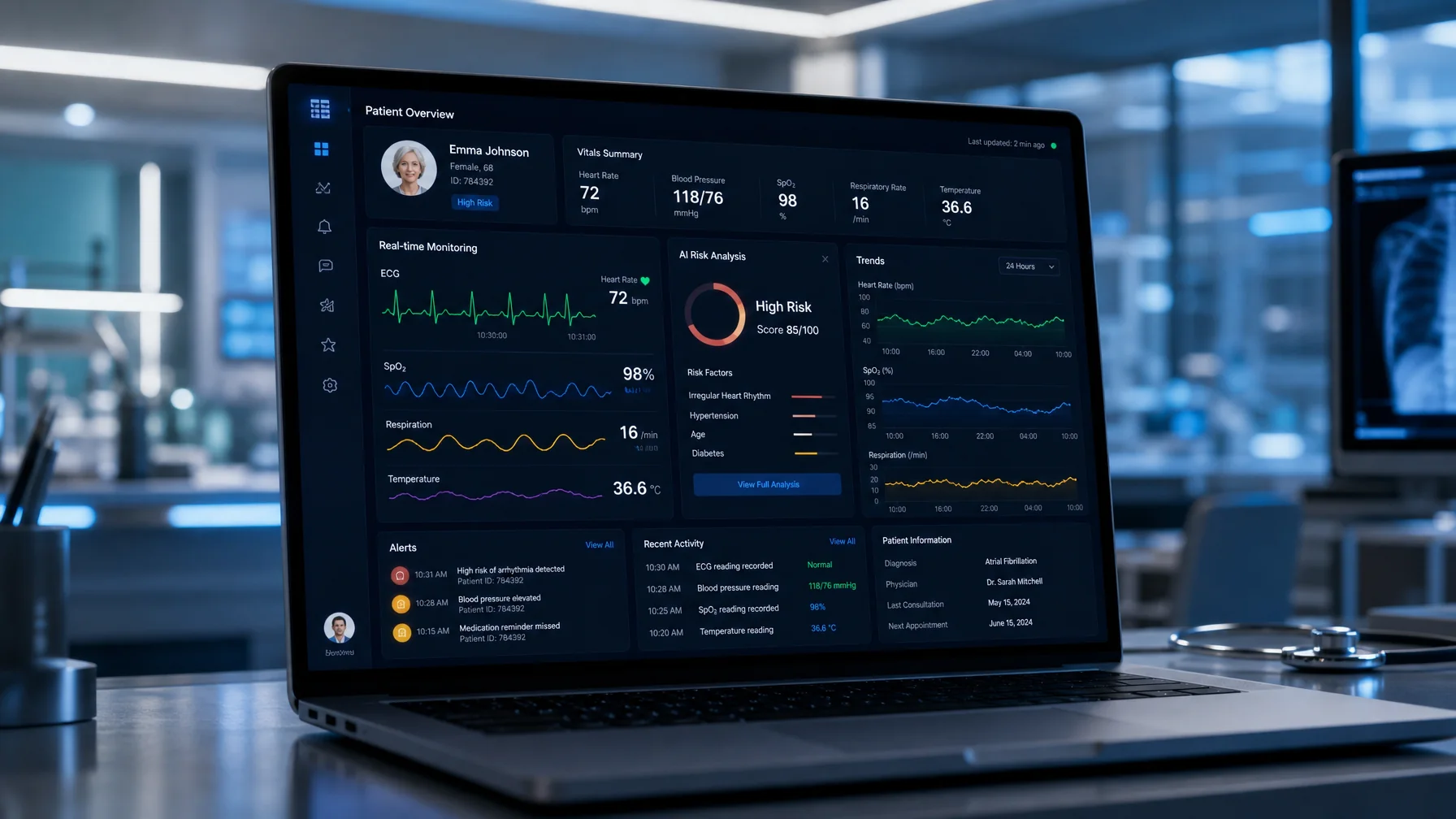
Designing HIPAA-compliant healthcare AI and remote patient monitoring platforms requires robust data security, continuous telemetry pipeline architecture, and strict regulatory adherence. Learn how senior software engineering teams construct scalable RPM infrastructure that safeguards PHI while delivering real-time clinical AI analytics.
- TLDR
- What Are the Core HIPAA Compliance Rules for Healthcare AI & RPM?
- The 4-Layer Architecture for Secure RPM Telemetry & AI Analytics
- FHIR & HL7 Integration: Connecting Wearables to Provider EHRs
- Safeguarding Protected Health Information (PHI) in AI Inference Pipelines
- Key Engineering Challenges & Mitigations
- Partnering with The Blue Box for HealthTech Engineering
- Conclusion
TLDR
Building a HIPAA-compliant Remote Patient Monitoring (RPM) and Healthcare AI platform requires an architecture that enforces zero-trust data governance from device ingestion to EHR delivery. Key technical requirements include end-to-end AES-256 and TLS 1.3 encryption, BAA-bound infrastructure, FHIR/HL7 interoperability, and automated PHI de-identification before model inference. The Blue Box designs and engineers custom, enterprise-grade HealthTech systems that combine real-time medical telemetry with secure AI risk scoring engines.
Quick Overview
| Architectural Layer | Core Responsibility | Primary Tech Stack & Security Protocols |
|---|---|---|
| 1. Edge & Ingestion Layer | Wearable & medical sensor telemetry streaming | BLE / Cellular, TLS 1.3, Ephemeral device caching |
| 2. Secure Pipeline & Storage | BAA-compliant ingestion, PHI encryption & audit logging | AWS KMS / GCP KMS, AES-256, Immutable Audit Logs |
| 3. AI Inference Engine | Anomaly detection, risk scoring & vitals analysis | De-identified feature vectors, Isolated AI Enclaves |
| 4. Provider & EHR Integration | Clinical alert dashboards & two-way EHR sync | SMART on FHIR, HL7 v2 / FHIR REST APIs |
What Are the Core HIPAA Compliance Rules for Healthcare AI & RPM?
Remote Patient Monitoring platforms collect continuous streams of Protected Health Information (PHI) via connected medical devices, mobile applications, and cloud-connected edge gateways. Integrating Artificial Intelligence for real-time anomaly detection and predictive risk scoring introduces stringent compliance obligations under the HIPAA Security and Privacy Rules.
Technical Safeguards
- Encryption at Rest and in Transit: All patient vitals, personal identifiers, and clinical telemetry must be encrypted using AES-256 at rest and TLS 1.3 in transit across all network boundaries.
- Business Associate Agreements (BAAs): Every cloud provider, database host, third-party API, and LLM vendor in the data pipeline must sign a legally binding BAA.
- Role-Based Access Control (RBAC) & Least Privilege: Access to identifiable health records must be strictly isolated using granular IAM policies, multi-factor authentication (MFA), and zero-trust perimeter controls.
- Immutable Audit Logging: Every system event, including data ingestion, record viewing, AI inference calls, and clinical alert dispatching, must generate tamper-evident audit logs retained according to healthcare compliance mandates.
The 4-Layer Architecture for Secure RPM Telemetry & AI Analytics
Deploying AI models on continuous stream data demands a modular, high-throughput system architecture that maintains compliance at every node.
The interoperability path from wearable telemetry to the provider's EHR looks like this:
┌────────────────────────────┐
│ Wearable Telemetry Stream  │
└─────────────┬──────────────┘
              │
              ▼
┌────────────────────────────┐
│ FHIR Transformation Engine │
└─────────────┬──────────────┘
              │ Maps telemetry to FHIR
              │ Observation resources
              ▼
┌────────────────────────────┐
│ EHR REST API Gateway       │
└─────────────┬──────────────┘
              │ OAuth 2.0
              ▼
┌────────────────────────────┐
│ Provider EHR System        │
└────────────────────────────┘
FHIR & HL7 Integration: Connecting Wearables to Provider EHRs
Interoperability is crucial for RPM adoption. Providers require seamless integration with major Electronic Health Record (EHR) platforms such as Epic, Cerner, and Athenahealth.
By leveraging standard FHIR (Fast Healthcare Interoperability Resources) structures, remote vital signs map directly to standard Observation and DiagnosticReport resources. This enables bi-directional data flow, allowing care teams to review remote monitoring metrics without leaving their existing clinical workflows.
Safeguarding Protected Health Information (PHI) in AI Inference Pipelines
Using commercial LLMs or custom machine learning models in healthcare requires strict safeguards against data exposure and model training leakage.
- Zero-Retention Policies: Any external API or model hosting partner must guarantee zero data retention and explicit exclusion from model training datasets.
- Deterministic De-identification: Implement automated tokenization pipelines that replace names, dates, and geographic markers with synthetic identifiers before passing clinical context to AI models.
- Human-in-the-Loop (HITL) Validation: AI generated risk flags must never execute automated clinical intervention without care team verification. AI serves as a decision support engine, surfacing high-priority signals for human review.
Key Engineering Challenges & Mitigations
| Challenge | Impact | Engineering Mitigation |
|---|---|---|
| High Telemetry Ingestion Volume | Pipeline latency & dropped vital signals | Distributed streaming queues with automatic partition scaling |
| EHR API Rate Limits | Delayed clinical alert delivery | Asynchronous webhook orchestration with exponential backoff retries |
| Model Drift & False Positives | Clinician alert fatigue | Continuous validation feedback loops & customizable threshold parameters |
| Intermittent Device Connectivity | Incomplete patient monitoring histories | Encrypted offline device storage with atomic synchronization upon reconnect |
Partnering with The Blue Box for HealthTech Engineering
Engineering high-volume, HIPAA-compliant platforms requires deep expertise in distributed systems, security protocols, and healthcare interoperability standards.
At The Blue Box, we build custom HealthTech software, remote patient monitoring platforms, and secure AI integration engines tailored to complex enterprise requirements. Our senior engineering teams work as direct technology partners to deliver robust, compliant digital products that scale.
Conclusion
Designing a secure, HIPAA-compliant Remote Patient Monitoring platform with AI capabilities is fundamentally an architectural challenge. By establishing clear isolation boundaries, end-to-end encryption, automated PHI scrubbing, and seamless FHIR interoperability, healthcare companies can unlock the power of real-time AI analytics while protecting patient privacy.
Ready to build or modernize your healthcare software platform? Contact The Blue Box software team today to discuss your system architecture and technical requirements.

Written byTHE BLUE BOX
Small team. Smart systems. Real impact.
Newsletter Signup