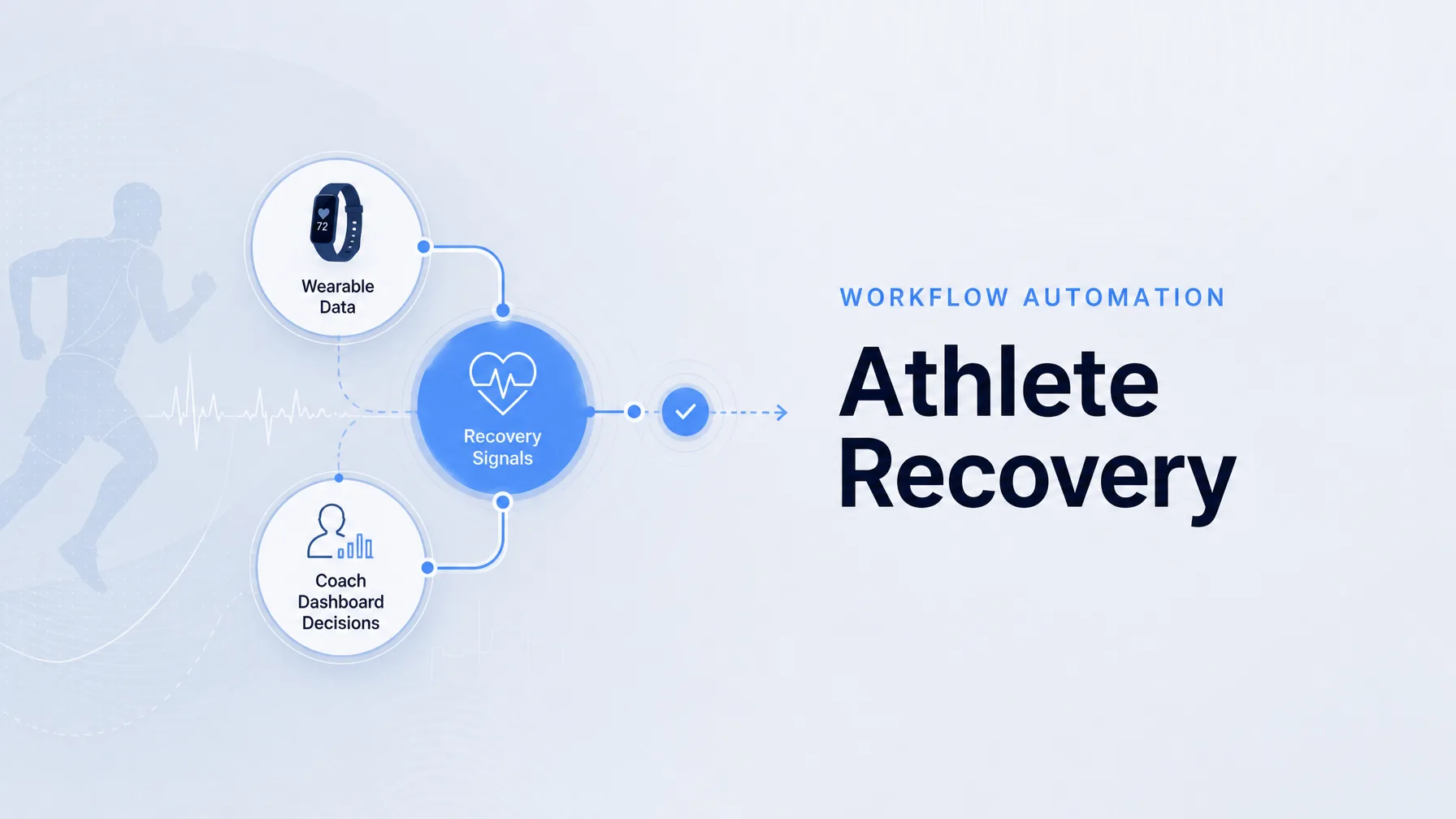
Workflow automation software becomes the operating system for athlete recovery when it connects wearables, check-ins, load, and coach decisions into one daily workflow. This guide covers architecture, failure modes, and how Recovery is built.
TLDR
Workflow automation software replaces manual handoffs with software that executes all or part of a process. In sports performance, that process is daily readiness: pull signals, interpret them against each athlete's baseline, route alerts, and put a clear decision in front of coaches and medical staff.
Most teams already own wearables, spreadsheets, and point tools. What they lack is a single workflow that turns sleep, HRV, load, and subjective wellness into the same green / yellow / red decision every morning. That is the job of a recovery operating system.
The Blue Box Recovery product is built as that system: ingestion, personalized baselines, multi-signal readiness logic, athlete check-ins, coach dashboards, and an embeddable SDK. This article is the architecture guide behind that design, and a practical playbook for CTOs and performance leaders who want workflow automation that holds up under real training calendars.
What Workflow Automation Software Actually Does
IBM defines workflow automation as optimizing processes by replacing manual tasks with software that executes all or part of a process. Atlassian frames it as automating business processes, tasks, and workflows with minimal human intervention. TechTarget describes the same idea as making the flow of tasks, documents, and information perform independently across work-related activities.
In plain terms, good workflow automation software does four things well:
- Ingests events from systems of record, including APIs, devices, forms, and files.
- Applies rules or models to decide what happens next.
- Routes work to people or downstream systems with context attached.
- Logs every step so teams can audit outcomes and improve the process.
Low-code connectors and RPA bots are useful for office workflows. Athlete recovery is different. The "document" is a multi-day physiological trajectory. The "approval" is a load decision that affects injury risk. The "audit trail" must explain why the system recommended rest after a heavy week, not only that a Zap fired.
That is why sports orgs outgrow generic automation tools. They need domain-specific workflow automation software that understands baselines, acute:chronic workload, missing data, and human override.
Why Athlete Recovery Needs an Operating System, Not Another Dashboard
Performance teams already collect data. The failure mode is fragmentation.
Typical stack in a club or academy:
- Wearables for sleep, HRV, resting heart rate, and strain
- GPS / power / jump systems for external load
- Spreadsheets or forms for RPE, soreness, mood, and sleep quality
- Chat threads for "is she cleared for full intensity?"
- Separate medical notes that never join the training plan
Athlete management systems exist to centralize those signals so coaches can balance training load, recovery, and injury risk. Firstbeat and similar platforms stress that value comes from combining physiological metrics such as HRV, HR zones, and TRIMP, recovery status, and long-term load trends such as acute:chronic workload ratio, not from any single score in isolation.
The market problem Recovery targets is the same one performance directors describe: tools stop at isolated metrics, such as sleep score, HRV score, and strain score. Coaches still have to assemble the story manually every morning. That manual assembly is a workflow problem.
An operating system for recovery answers one daily question with full context:
Given this athlete's baseline, last night's recovery signals, cumulative workload, and subjective wellness, what should training look like today?
When that answer is consistent, explainable, and shared across athlete, coach, and medical staff, you have workflow automation. When it lives in five tabs and a WhatsApp group, you have data collection without a process.
Sports science literature treats monitoring as a system problem as well. Work on training load and fatigue and broader athlete monitoring frameworks frames load, internal response, readiness, and recovery as linked blocks. Software that only charts one block fails the real job.
The Four Layers of a Recovery Operating System
Treat workflow automation software for recovery as four stacked layers. Skip one and the product becomes shelfware.
1. Data ingestion and identity
Every signal needs a stable athlete identity, device provenance, timestamps, and unit normalization.
- Physiological: HRV, RMSSD, SDNN, LnRMSSD, resting heart rate, respiratory rate, and temperature
- Sleep: duration, efficiency, awakenings, deep / REM, and consistency
- External load: GPS, power, sprints, jumps, session duration, and intensity
- Internal load: heart rate zones, TRIMP, and RPE
- Subjective wellness: mood, soreness, fatigue, motivation, stress, and perceived readiness
Wearable ecosystems are fragmented. Open infrastructure and SDKs matter here. Open Wearables is The Blue Box's contribution to that layer: open infrastructure plus a React Native SDK so mobile products can connect health and activity signals without rebuilding every device integration from scratch.
2. Personalization and baselines
Population norms mislead. A "good" HRV for one athlete is suppressed for another. Effective systems maintain personalized baselines for HRV, sleep, resting heart rate, load tolerance, and wellness patterns, then score deviations against that person, sport, and training phase.
Without baselines, automation either over-alerts or under-alerts. Both kill adoption.
3. Decision and alert logic
This is the core workflow engine:
- Multi-day pattern detection, such as HRV suppression + rising RHR + poor sleep + rising load
- Load risk signals, including ACWR spikes, asymmetry, and post-injury imbalance
- Daily readiness outputs, green / yellow / red, with plain-language reasons
- Escalation rules for medical review vs coach-only flags
- Human override with logged rationale
Example output a coach can act on:
HRV is 14% below baseline, acute workload is up 32%, and sleep was 1 hour short. Reduce intensity today and prioritize recovery.
That sentence is workflow automation. A raw HRV chart is not.
4. Surfaces, roles, and integration
The same engine must serve different roles without forking the truth:
- Athlete app: check-ins, readiness view, and recovery guidance
- Coach / medical dashboard: roster status, trends, overrides, and reports
- SDK / API: embed the engine into existing club platforms, white-label products, or partner apps
- Admin: permissions, audit logs, data retention, and export
Delivery models that work commercially: standalone SaaS for clubs and academies, embedded SDK for platforms that already own the athlete relationship, white-label AMS for federations, and managed service for teams that want continuous algorithm improvement. Recovery is designed for all four paths on purpose. See the Recovery product page for the full product architecture.
What Goes Wrong When Teams Automate Recovery the Wrong Way
Enterprise automation fails for predictable reasons. The same patterns show up in sports tech builds.
1. Automating a broken process
If the club has no agreed definition of "ready," software will encode arguments. Map the human workflow first: who decides load, what evidence they require, and what happens on yellow flags. Then automate the agreed path.
2. Tool selection without integration depth
Buying three best-of-breed devices and hoping they "talk" produces CSV exports and dual entry. Workflow automation software earns its keep at the integration layer: identity resolution, late data, missing check-ins, and conflict rules when two devices disagree.
3. Metrics without decisions
Dashboards look impressive in demos. Staff abandon them when nothing routes a clear next action. Pair every high-value metric with a workflow: alert owner, SLA, allowed actions, and closed-loop feedback after the session.
4. No ownership of model quality
Readiness models drift as seasons change, rosters turn over, and devices update firmware. Assign owners for baseline recalibration, false-positive review, and sport-specific tuning. RAND research on AI project failure highlights a related enterprise pattern: models optimized for the wrong metrics or poorly fit to real workflows fail after deployment. Recovery systems are no exception.
5. Ignoring the human gate
Full auto-adjustment of elite training plans without coach override destroys trust. Design for augmented decisions: the system proposes, staff confirm or override, and the log captures why. That pattern scales better than pure automation in high-stakes environments.
6. Privacy and consent as an afterthought
Athlete biometric and wellness data is sensitive. Build consent, role-based access, retention, and export controls into the first sprint. Recovery publishes an explicit privacy and data handling policy for this reason.
Reference Architecture: How Recovery Is Built
Recovery is The Blue Box's readiness and recovery intelligence product for athletes, coaches, sports organizations, and performance teams. It is a concrete example of domain workflow automation software, not a generic connector suite.
Product ecosystem, not a single screen
- Backend intelligence engine: profiles, wearable data, baselines, algorithms, and integrations
- Athlete mobile app: check-ins, readiness view, and recovery guidance
- Mobile SDK: embed the engine in partner apps and existing sports platforms
- Admin dashboard: coaches, medical staff, and performance managers
Signal model
Recovery fuses four signal families into one contextual model:
- Physiological recovery
- Sleep quality
- Training workload, external + internal + ACWR
- Subjective wellness
"Load" means training workload / training stress, not fatigue by itself. Fatigue is inferred from multi-day patterns across families.
Intelligence outputs
- Personalized baselines
- Adaptive recovery score by sport, profile, and available data
- Fatigue detection from multi-day patterns
- Injury risk signals combining load spikes, asymmetry, sleep, soreness, and post-injury imbalance
- Daily readiness prediction with green / yellow / red recommendations
Commercial packaging
Clubs can run Recovery as SaaS. Platforms can license the SDK. Federations can white-label. Partners such as athlete ecosystems can use it as a data intelligence layer. That flexibility is a product decision that starts at architecture: clean APIs, multi-tenant tenancy, and role-aware surfaces from day one.
If you are evaluating partners for this class of system, look for teams that ship automation-first platforms for regulated and high-stakes domains, not only consumer fitness UIs. The Blue Box builds automation systems, AI integrations, and wearable-driven products across HealthTech and sports tech, including SwimAI, Open Wearables, and Recovery.
Build vs Buy vs Embed
Buy SaaS AMS fits when a club needs roster-level readiness fast and has limited engineering capacity. The main risk is weak fit to custom sports, closed data, and a system that is hard to productize later.
Build in-house fits when differentiated IP is the business and the team has a strong sports science and engineering bench. The main risk is integration debt, model maintenance, and multi-year cost.
Embed SDK / white-label fits when you already own the athlete app or federation portal. The main risk is vendor lock-in if contracts ignore data portability.
Hybrid fits when the core readiness engine comes from a specialist and the UX and branding stay in-house. The main risk is unclear API SLAs or an unresolved joint roadmap.
Most performance startups over-build dashboards and under-build the workflow engine. Invert that: nail ingestion, baselines, decision logic, and audit first. Surfaces can iterate weekly. The engine cannot.
For internal ops automation outside sports, including finance ops, compliance routing, and supply chain, the same layering applies. See related Blue Box work on automation and internal systems and client automation case studies such as Lambrucar's supply chain system.
How to Scope a Recovery Automation Project That Sticks
Use this sequence when you write an RFP or internal charter.
Step 1: Define the daily decision
Write the exact question the system must answer by 8:00 a.m. local time. Example: "For each athlete on the gameday-minus-two roster, recommend full / modified / rest with top three reasons."
Step 2: Inventory sources and missingness
List devices, exports, and form compliance rates. Design for incomplete data on day one; real athletes skip check-ins and forget chargers.
Step 3: Agree override policy
Who can clear a red flag? How is that logged? How does the model learn from overrides without silently weakening safety?
Step 4: Choose the thinnest successful surface
Start with coach roster view + athlete check-in. Delay fancy long-term analytics until daily workflow adoption is stable for two training blocks.
Step 5: Instrument success
Track:
- Percent of athletes with complete overnight + check-in data by decision time
- Coach time from login to load plan
- Override rate and reasons
- Soft-tissue incident rate vs prior season, directional rather than causal claims
- Athlete trust score, using a simple weekly pulse
Step 6: Plan the product path early
If the system might become SaaS, SDK, or white-label later, multi-tenant boundaries and API design belong in v1. Retrofitting tenancy is expensive.
Conclusion
Workflow automation software is not a catalog of connectors. It is the discipline of turning repeated decisions into reliable, auditable processes. For athlete recovery, that decision is readiness under load: fuse wearable and training signals, personalize to each athlete, and put a clear action in front of the people who own performance and health.
Teams that stop at dashboards stay stuck in morning war rooms. Teams that build a recovery operating system free coaches to coach, give medical staff earlier signals, and give athletes a consistent story about why today's plan looks the way it does.
Recovery is The Blue Box's implementation of that operating system: intelligence engine, athlete app, coach dashboard, and embeddable SDK. If you are scoping readiness automation for a club, federation, or sports platform, book a strategy call or request an automation audit.
Sources
- IBM: What Is Workflow Automation?
- Atlassian: What is Workflow Automation?
- TechTarget: Workflow automation definition
- Firstbeat: How a Good Athlete Management System Benefits Teams and Coaches
- PMC: Monitoring Training Load to Understand Fatigue in Athletes
- MDPI: Optimizing Athletic Performance. Systems Framework for Adaptive Athlete Monitoring
- RAND: Root Causes of Failure for Artificial Intelligence Projects
- The Blue Box Recovery
- Open Wearables

Written byTHE BLUE BOX
Small team. Smart systems. Real impact.
Newsletter Signup