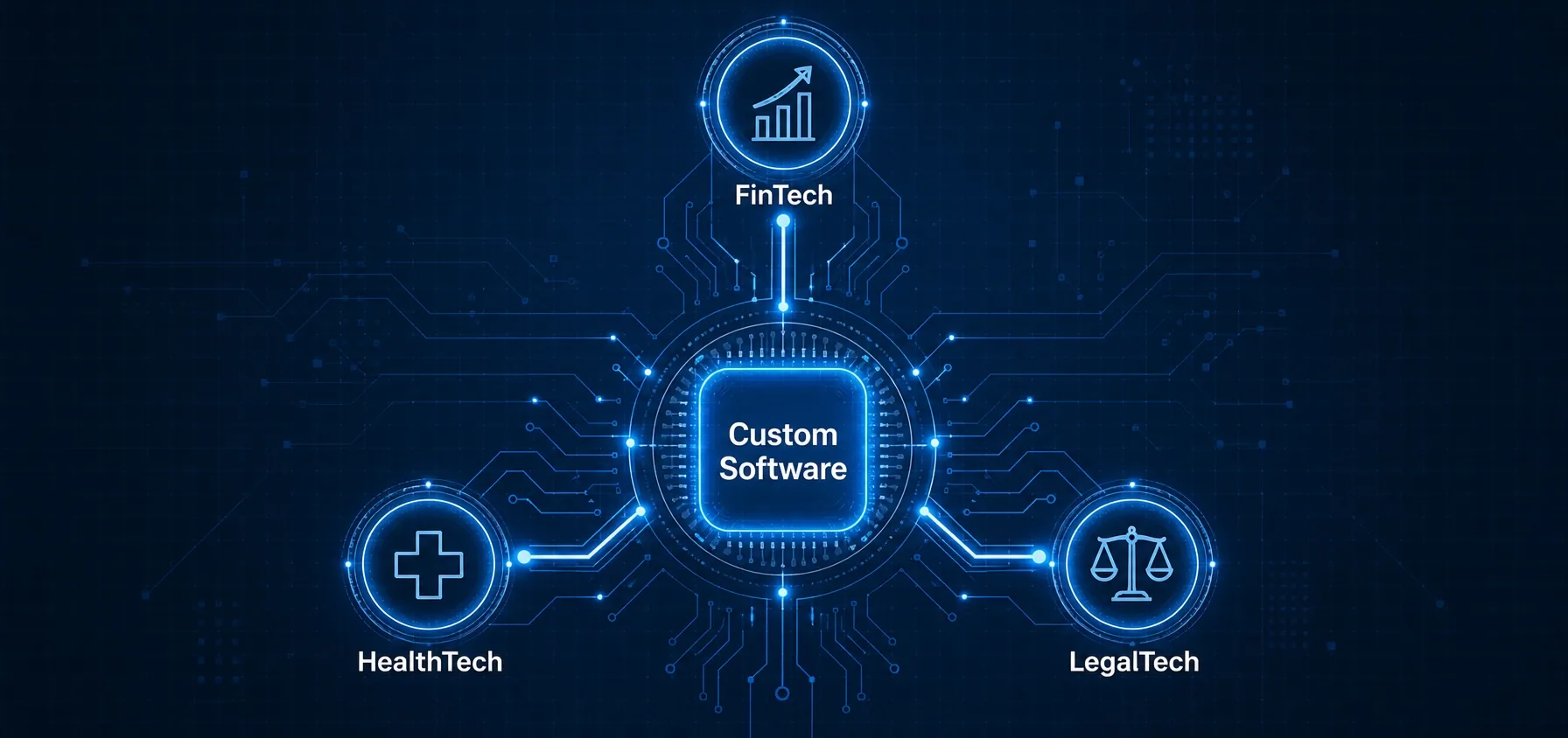
Custom software development built for regulated industries — FinTech, HealthTech, LegalTech — demands more than good code. This guide gives CTOs and Founders the decision framework to choose right.
TLDR
Generic SaaS tools fail regulated industries for a simple reason: they are built for the average company, not yours. Custom software development gives FinTech, HealthTech, and LegalTech organizations control over compliance architecture, data sovereignty, and integration logic from day one. This guide covers how to make the decision, what to look for in a partner, and how to build fast without creating regulatory debt.
The custom software development market reached $43.16 billion in 2024 and is projected to hit $146.18 billion by 2030 at a 22.6% CAGR. (Grand View Research, 2025) That growth is not driven by startups experimenting with features. It is driven by regulated industries — financial services, healthcare, legal — that hit the ceiling of generic tooling and need systems built to their exact operating constraints.
Yet only 27% of senior executives report that their technology is fully aligned with their business objectives. (Grant Thornton, 2025) The gap between what SaaS vendors promise and what regulated businesses actually need is the root cause of that misalignment.
If you are a CTO or Founder running a business in FinTech, HealthTech, or LegalTech, this is the decision framework you need before your next engagement with a custom software development company.
Why Generic Software Fails Regulated Industries
Off-the-shelf software is designed for horizontal markets. It optimizes for the 80% use case across industries. For most B2C companies, that trade-off is acceptable. For regulated industries, it is not.
Here is where the failure points appear:
Compliance architecture is an afterthought. Most SaaS platforms are not built with HIPAA, SOC 2, PCI-DSS, or EU AI Act compliance as a structural requirement. Compliance features get bolted on after the core product is shipped. For a HealthTech platform, that means audit trails, data minimization, and access controls are often surface-level — not wired into the system's data flow. The average US healthcare data breach now costs $7.42 million, and healthcare has ranked as the most expensive industry for breaches for 14 consecutive years. (HIPAA Journal, 2025) HIPAA civil penalties reach up to $2.13 million per violation category annually under Tier 4 (willful neglect, uncorrected). Generic software carries that risk quietly.
Integration inflexibility creates data silos. FinTech organizations need real-time connections to payment rails, core banking systems, fraud detection engines, and regulatory reporting pipelines. Off-the-shelf tools rarely provide the API depth required for those integrations. The result: engineering teams spend significant time building middleware workarounds — which become the most fragile parts of the stack.
Vendor lock-in erodes strategic control. When a regulated business runs critical workflows inside a SaaS platform it does not control, every pricing change, API deprecation, and security incident becomes the business's problem with no recourse. In LegalTech, where matter data and document processing logic represent proprietary operational knowledge, that dependency is a strategic liability.
Custom software development fixes all three failure modes because the architecture reflects the specific compliance requirements, integration topology, and data governance model of one organization.
The Build-vs-Buy Decision in FinTech, HealthTech, and LegalTech
The build-vs-buy decision is not a binary choice. Most regulated organizations operate on a spectrum — some commodity workflows handled by SaaS, some proprietary or compliance-sensitive workflows on custom systems. The question is where to draw the line.
A practical decision framework by vertical:
FinTech
Build custom when:
- Core transaction processing, risk scoring, or lending logic is a competitive differentiator
- Regulatory reporting requires real-time data from multiple proprietary sources
- The business operates across multiple jurisdictions with different compliance schemas
Buy off-the-shelf when:
- The functionality is a commodity (HR tooling, internal communication, standard accounting)
- The SaaS vendor has explicit, auditable compliance certifications for your jurisdiction
The FinTech compliance landscape in 2026 is sharply more demanding than three years ago. Regulators now audit how systems work in real time — how they verify users, control data access, and flag suspicious activity — not just what the policy documents say. (Relevant Software, 2026) Systems that were acceptable in 2022 require architectural rework to meet current standards.
HealthTech
Build custom when:
- The platform handles PHI (Protected Health Information) in ways that require granular access controls
- Clinical workflows demand specific EHR integration logic (Epic, Cerner, custom HL7/FHIR pipelines)
- AI or ML components are embedded in clinical decision support, where the EU AI Act and FDA software guidance impose strict governance requirements
Buy off-the-shelf when:
- The use case is clearly non-clinical (internal scheduling, non-PHI analytics, team communication)
HIPAA and HITECH remain the baseline, but 2026 HealthTech operators also face new CMS mandates, state-level privacy laws, and AI governance rules layered on top. Manual processes and generic SaaS platforms cannot keep pace with that complexity. (wayoh.co, April 2026)
LegalTech
Build custom when:
- Matter data, document classification, or case workflow automation represents IP that should not leave the organization's infrastructure
- Search and retrieval systems need domain-specific fine-tuning on legal corpora
- Client confidentiality requires on-premise or private cloud deployment models
Buy off-the-shelf when:
- Commodity productivity tools with established legal certifications serve the need
The pattern across all three verticals is consistent: wherever compliance is structural, wherever data is sensitive, and wherever the workflow is a differentiator — custom software development is the right call.
What to Evaluate in a Custom Software Development Partner
Choosing the wrong development partner is one of the most expensive mistakes a technology leader can make. Research shows nearly one-third of software projects are canceled before completion, and over half exceed their original budget. (Vervali, 2026) The quality of the development team and process is the primary variable.
Five criteria to evaluate before signing:
1. Vertical domain knowledge — not general "tech experience." A development partner who has shipped systems for FinTech regulators, HealthTech data pipelines, or LegalTech document processing understands the operational constraints your engineers live with. Domain-naïve teams produce technically sound code that fails compliance reviews.
2. Architecture-first delivery model. The first output of any serious custom software engagement should be a system architecture document — not wireframes, not a product roadmap. Before a line of code is written, the team needs to have defined the data flow, integration points, compliance boundaries, and scalability model. Teams that skip this step produce features, not systems.
3. No-handoff senior team structure. The person who scopes the project should be on the team that builds it. Agencies that sell the engagement with senior engineers and staff it with juniors create a knowledge transfer gap that costs time and introduces risk. Demand clarity on exactly who will own architecture decisions.
4. Track record with integrations, not just interfaces. In regulated industries, the most complex and highest-risk engineering work is integration work — connecting systems across audit boundaries, maintaining data integrity across service calls, and building pipelines that survive real production load. Ask for specific case examples of integration architecture, not just demos of UI.
5. Security and compliance posture as a default, not an add-on. Ask directly: how does the team handle secrets management, access control, audit logging, and data residency requirements? If the answer involves third-party plugins applied at the end of the build, that is a signal.
Building for Compliance Without Slowing Delivery
A persistent misconception in regulated industries is that compliance and delivery velocity are in tension. They are not — when compliance requirements are built into the architecture at the start.
The practices that eliminate this tension:
Compliance-as-code from day one. Infrastructure-as-code pipelines that embed access controls, audit logging, and encryption configuration into the deployment process mean compliance is enforced automatically with every build. It is not a checklist that runs before launch.
Event-sourced architecture for audit trails. In FinTech and HealthTech, regulators require complete audit trails of system state changes. Event-sourced architectures produce audit logs as a byproduct of normal operation — not as a separate logging layer that can be bypassed.
Modular compliance boundaries. Systems that separate data processing, storage, and access into distinct, independently deployable services can adapt to new regulatory requirements without full rebuilds. When LATAM data sovereignty rules tighten or a new FDA guidance drops, the boundary of change is a service — not the entire platform.
AI governance built into the model pipeline. For HealthTech and FinTech organizations embedding AI, the EU AI Act's August 2026 enforcement timeline means model versioning, bias monitoring, and explainability are now table stakes — not optional governance features. AI systems without these components in the architecture face retroactive rework that is significantly more expensive than building them in from the start.
The Bottom Line for Technology Leaders
Custom software development is not a premium option for organizations that want something nice. For FinTech, HealthTech, and LegalTech businesses, it is often the only option that actually works — the only path to a system that aligns with compliance requirements, integrates with real infrastructure, and gives the business long-term control over its most critical operations.
The decision framework is clear: when the workflow is proprietary, when the data is regulated, or when the integration logic is a competitive differentiator, build custom. When the use case is a commodity, buy.
The more consequential decision is who builds it.
The Blue Box is a boutique software studio that builds automation-first platforms and AI-powered systems for FinTech, HealthTech, and LegalTech organizations. We work as a senior, hands-on team — no handoffs, no layers — focused on architecture-first delivery and real business impact.
If you are evaluating your next custom software investment, start with a strategy conversation. We work with CEOs, CTOs, and VPs of Engineering who need a partner that understands the operational and regulatory context of what they are building.

Written byTHE BLUE BOX
Small team. Smart systems. Real impact.
Newsletter Signup