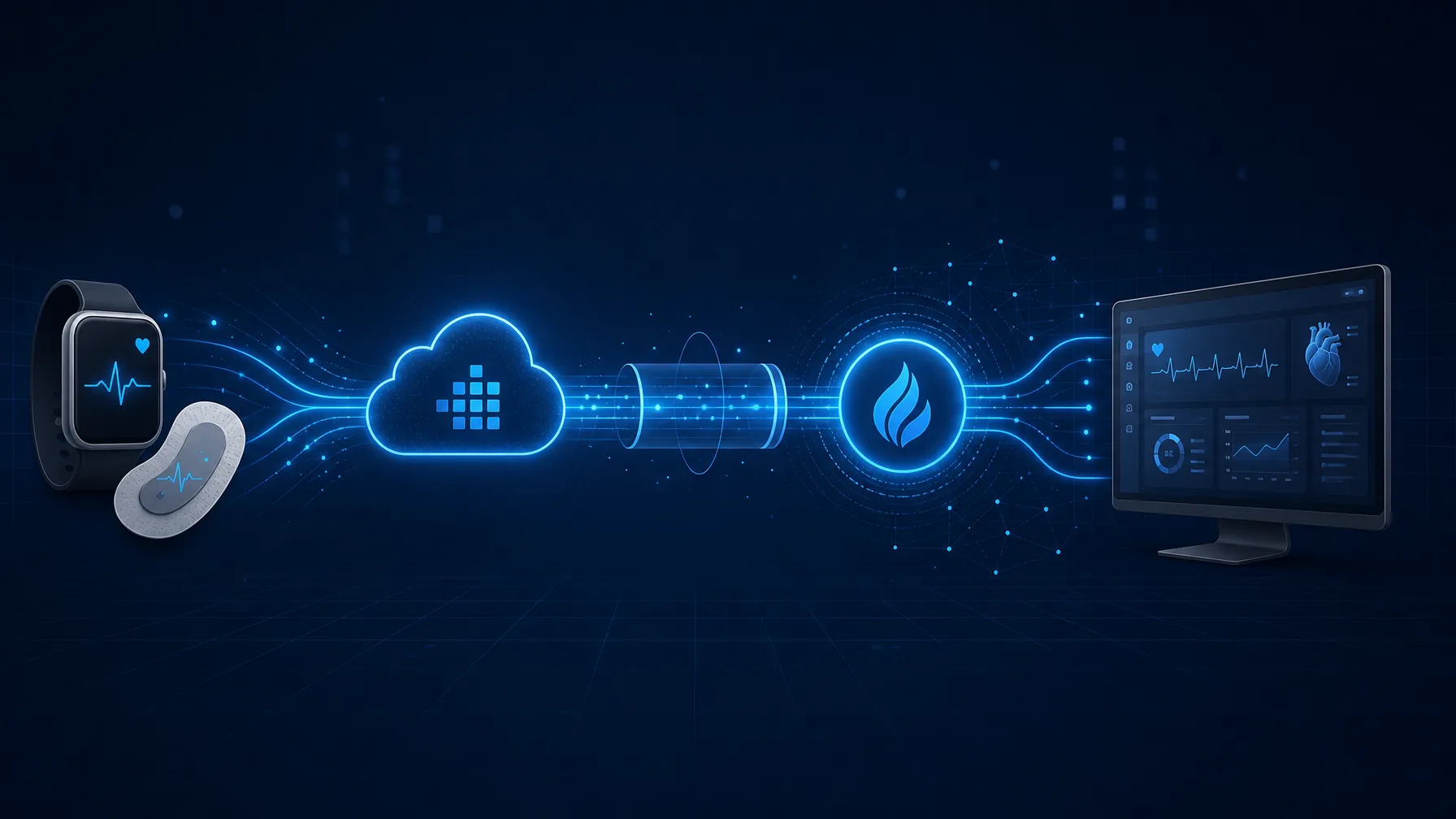
How HealthTech engineering teams build production-grade remote patient monitoring software — architecture, HIPAA, AI pipelines, and the build vs. buy decision.
The remote patient monitoring (RPM) market sits at $36.3 billion in 2026 and is growing at a 12.8% CAGR. Off-the-shelf RPM platforms handle generic workflows — they were not designed for your device ecosystem, your clinical logic, or your compliance posture. This guide breaks down the architecture, compliance requirements, and build vs. buy decision framework that engineering leaders need to make the right call before committing a six-figure budget.
The assumption that off-the-shelf remote patient monitoring software is "good enough" is costing HealthTech teams time, money, and clinical trust. The RPM market grew from $31.8 billion in 2025 to $36.3 billion in 2026 — and that growth is fueled not by platforms staying the same, but by organizations discovering that generic tools cannot carry them past a certain scale (MarketsandMarkets, 2026).
If you're a CTO or VP of Engineering at a digital health company, a hospital system building a remote care program, or a HealthTech startup entering this space, the architecture decisions you make today will determine whether your platform is a clinical asset or a maintenance liability in two years.
This guide covers what a production-grade RPM platform actually looks like under the hood, where the hard engineering problems live, and how to decide whether to build custom or buy a vendor solution.
Vendor RPM solutions are optimized for broad adoption, not deep fit. They work well in the evaluation phase — clean dashboards, quick device integrations, SOC 2 badges on the sales deck — and show their limits within 12 months of production usage.
Three patterns emerge consistently:
Device coverage gaps. With over 1,350 FDA-authorized connected health devices on the market as of 2026, no single off-the-shelf platform supports all of them. The moment your clinical or commercial team wants to add a new glucometer, ECG patch, or spirometer, you're filing a vendor feature request and waiting.
Rigid alerting logic. Generic platforms alert on population-level thresholds. A 40-year-old post-cardiac patient and an 80-year-old CHF patient do not share the same meaningful vital ranges. Clinical alerting that cannot be parameterized per-patient, per-condition, or per-care-protocol generates alert fatigue — and alert fatigue is a patient safety risk.
Integration ceilings. Modern hospital workflows require RPM data to flow bidirectionally into EHR/EMR systems. Most SaaS RPM platforms offer outbound FHIR R4 exports, but true bidirectional EHR integration — where care plans, medication changes, and discharge summaries inform the monitoring logic in real time — requires architectural access the vendor does not expose.
A custom RPM platform is not a single application. It's a pipeline of interconnected systems with different latency, persistence, and compliance requirements at each layer.
Raw biometric data from wearables and connected devices is noisy. Heart rate sensors return artifact spikes. Blood pressure cuffs misfire on motion. A production ingestion layer must filter signal from noise at the edge — before data reaches your cloud infrastructure — to avoid contaminating downstream analytics.
The ingestion layer handles:
Once clean data enters your infrastructure, it feeds a streaming pipeline — Apache Kafka or AWS Kinesis are the standard choices — that routes events to three consumers: the alerting engine, the storage layer, and the analytics service.
The critical engineering constraint here is latency. For acute monitoring use cases (post-surgical, hospital-at-home), alert-triggering latency must be sub-minute. For chronic condition management (diabetes, hypertension), near-real-time is acceptable. Your architecture needs to handle both modes without separate infrastructure.
All patient health data entering your platform should be normalized to HL7 FHIR R4 on ingestion. This is not optional if you intend to integrate with hospital EHR systems — Epic, Cerner, and Oracle Health all expose FHIR R4 APIs, and bidirectional integration requires your data model to match.
FHIR normalization also future-proofs your compliance posture. The HHS Information Blocking Rule enforcement, now active, requires covered entities to make patient data available in standard formats. Building to FHIR R4 from day one eliminates a painful retrofit later.
The alerting engine is where the majority of custom logic lives. A well-designed alerting layer separates rule execution from rule definition — care teams configure alert conditions through a clinical rule interface without requiring engineering deployments.
Key design decisions:
Every RPM platform handles Protected Health Information (PHI). HIPAA compliance at the application layer means more than encrypting data at rest and in transit. The specific requirements that catch engineering teams off guard:
Minimum necessary access. Each system component should only access the PHI it needs to execute its function. A notification service that sends SMS alerts should not have read access to full patient records.
Audit logging at the data layer. Every PHI access event — read, write, export, delete — must be logged with user identity, timestamp, and purpose. Most teams add this after the fact as a middleware concern; the right approach embeds it in the data access layer from the start.
Business Associate Agreements (BAAs) across your entire vendor chain. Your cloud provider, your analytics tooling, your notification service, your logging infrastructure — every vendor that touches PHI requires a signed BAA. A single unverified vendor in the chain is a HIPAA violation waiting to be discovered.
Model governance for AI components. If your RPM platform uses machine learning for anomaly detection or predictive alerts, the FDA's Pre-Determined Change Control Plans (PCCP) framework — formalized in the 2024 AI/ML guidance update — requires you to document how the model changes over time and what clinical validation gates apply. This is not optional for FDA-regulated SaMD (Software as a Medical Device) classifications.
The clearest ROI case for custom RPM software over off-the-shelf is AI-powered anomaly detection. Generic platforms use static thresholds. Custom platforms use patient-specific baselines that adapt over time.
A production anomaly detection layer for RPM typically uses an LSTM or transformer architecture trained on longitudinal patient data. The model learns what "normal" looks like for each patient across time-of-day, activity level, and seasonal variation — and flags deviations that fall outside that envelope, not outside a generic population range.
The practical result: fewer false positive alerts, earlier detection of clinically meaningful changes, and a system that becomes more accurate as it accumulates patient history. That feedback loop does not exist in vendor platforms because the model is shared across their entire customer base, not trained on your patient population.
The honest answer is that this is not a binary choice. Most mature RPM programs use a hybrid model: a vendor platform for speed-to-market in the first 12 months, and a custom build for the components where differentiation and clinical depth actually matter.
Use this framework to identify where custom development is worth the investment:
| Signal | Recommendation |
|---|---|
| Your device ecosystem is not covered by any single vendor | Custom ingestion layer |
| Your clinical alerting logic is condition-specific and parameterized per patient | Custom alerting engine |
| You need bidirectional EHR integration beyond read-only FHIR exports | Custom integration layer |
| You need AI anomaly detection trained on your patient population | Custom ML pipeline |
| You're building an RPM product (not just using one) | Full custom platform |
| You need basic vital monitoring for a single chronic condition | Vendor platform, move fast |
Custom RPM development with a senior engineering team runs $200K–$400K for a full platform (ScienceSoft). Modern AI-assisted delivery timelines have compressed by 40–70% versus 2022 estimates (ideas2it, 2026), making the build path more accessible than the legacy cost estimates suggest.
Three engineering decisions that look minor during scoping and become significant post-launch:
Offline-first mobile architecture. Patients in rural or low-connectivity environments cannot lose monitoring continuity when they lose signal. A mobile app that fails gracefully, queues readings locally, and syncs reliably on reconnection is not an edge case — it is a clinical requirement.
Multi-tenancy and care team hierarchy. An RPM platform serving multiple hospital departments, care programs, or client organizations needs a data model that enforces strict tenant isolation while allowing cross-team escalation. Retrofitting multi-tenancy into a single-tenant architecture is one of the most expensive refactors in HealthTech.
Versioned clinical logic. As clinical guidelines change, your alerting rules and care protocols change. A platform that cannot version and roll back its clinical logic — and audit which logic was active for a given patient at a given time — creates liability exposure during adverse event reviews.
Building custom remote patient monitoring software is the right call when your clinical differentiation depends on it. The platform complexity is real — device ingestion, FHIR normalization, HIPAA-grade audit infrastructure, AI anomaly detection, and regulatory compliance all have to be in production simultaneously, and they have to work together.
The teams that get it right are the ones with prior HealthTech architecture experience. Not because the individual components are exotic, but because the compliance constraints and clinical logic requirements change how every standard pattern gets implemented.
The Blue Box builds custom RPM platforms and HealthTech data pipelines for digital health startups and enterprises. Our team has direct experience with HIPAA-compliant architectures, FHIR R4 integration, and AI-powered anomaly detection in production environments. If you're scoping a custom RPM build or evaluating whether your current platform can scale, let's talk.
Equipo chico. Sistemas inteligentes. Impacto real.
Suscripción al newsletter